Friday, February 28, 2014

I'm Not in Kansas Anymore!

Tuesday, May 10th - - It never crossed my mind that I'd spend nearly six days in Kansas, much less enjoy most of it! Crossing over into southeastern Colorado the countryside looked much the same as it had in western Kansas. Fields were under cultivation to begin with but as I ventured further south and west there were more vast expanses of prairie.


However, within a few hours, the view changed dramatically. Mountain peaks touched with a dusting of snow could be seen off in the distance. It wasn't long before they loomed much larger and closer. With the change in view came a dramatic change in daytime temperature – from a high in the upper 90s to a high in the mid 50s. Thank goodness that, unlike the air conditioner, the heater in the van works!


West of Walsenburg, Colorado on U.S. Highway 160/285.

My destination for the night was the Great Sand Dunes National Park and Preserve, near Alamosa. I had visited there once before, way back in May of 1979.


This time, Mother Nature was definitely not cooperating with me. The further west I traveled, the cloudier it got. Once at The Dunes, the sun would occasionally peek out from behind the clouds, but even then the lighting wasn't that great. This is the view from my campsite. The base of The Dunes is about a mile and a half distant.


The image above and those following have been modified. I was going to say “enhanced” but that is entirely dependent upon who is viewing the images. Since you aren't going to see the originals, suffice to say that I think these are an improvement over the originals, considering the lighting conditions at the time.


Human figures add a little perspective on the size of these dunes. They (The Dunes) truly are magnificent.


And from what I remember from back in 1979, they are extremely difficult to walk on. I did go out to the base of The Dunes but simply did not have the energy or stamina to go any further. Besides, it was getting late in the evening, a strong wind was blowing, and it was cold!


The quality of light was pitiful, and it was nearly gone, but the views were still awesome even though they can't truly be captured by the camera.


Thursday, February 27, 2014

Will You Still Love Me Tomorrow?

Vertical Mile Road
Listening to cyclists' stories about their first long or difficult rides, I often hear things like "Afterward, I wanted to throw my bike away" or "The next day, I couldn't even look at my bike."


It always struck me as interesting how the feelings of pain and exhaustion caused by riding can become associated with the bike itself. In a sense, it is easier to think of the bike, a concrete object, as the source of our discomfort than it is of a deficiency in fitness or endurance on our part.We look at the bike and remember how we felt during that hard ride.It's not so much that we literally blame the bicycle, as that the bike becomesa signifier of the pain and exhaustion we experienced. That feeling of wanting to throw it out, or not wanting to look at it, is a way of dealing with frustration over our own limitations.And of course this is in addition to the possibility that the bike itself is at least partly to blame - be it through saddle discomfort, harshness of ride, inappropriate gearing, or bad positioning.


If only mildly, I have had my share of all this. I've overdone it before, to the point of fatigue at the mere sight of a bike that only time away from it could cure.


But I am thinking of this now, because more recently I've experienced something of the opposite. Still feeling battered and drained after an especially tough ride, the morning after I walked past the bike and thought about how much I loved it, and about how much I loved cycling. It was an unexpected reaction, having tumbled out of bed feeling as if a train had run over me. After a day of passion and heartbreak, it feels good to still love it all, and to want to ride again tomorrow.

Product Review: The Winter Beard


With winter in full swing here in New England, increasing numbers of gentlemen cyclists sport a popular cold weather accessory: the winter beard. Even for those normally clean shaven, this effectiveand budget-friendly solution can be hard to resist once the frost sets in.


Having surveyed a number of male cyclists, the most popular means of obtaining a winter beard seems to be the DIY method: Simply stop shaving your face, and in as little as a week you could find yourself in possession of a modest to moderate wooly facial appendage. In weather that's merely cool, that might very well suffice. In harsh winter climates, continue growing to taste, or until coworkers/ loved ones begin to complain. To shorten or shape, use a beard trimmer.


Maintaining your winter beard is simple: Handwash with soap and water, and check for trapped food particles after meals. If you notice people staring at the lower half of your face in disgust, you may not be performing these maintenance tasks diligently enough. Otherwise, you are probably fine.


The winter beard has many benefits. It is temperature-regulating,wind-proof, breathable and quick drying - more so than any wool or synthetic balaclava on the market. It isnatural, organic, and ethically grown.It is inexpensive.You are unlikely to lose it or leave home without it.And itcolour coordinates with any outfit.


Possible drawbacks include extra maintenance, and potential protests from your significant other.In the event of the latter, I suggest pointing out the communal usefulness of your beard: For instance, it can function as a loofa-like facial exfoliant for your spouse, or a scratching post for your cat.


In growing your winter beard, pay attention not only to length, but to total area of coverage:The most effective beards are as thick nearer to the neck as they are at the chin, providing the warmth of an extra scarf.


And finally, do exercise moderation. Localcartoono-anthropologist has documented breakouts ofCompetitive Beard Growingdisorder among cyclists in winter, which are not without side-effects.Sure your luscious facial locks might impress your friends and terrify your enemies, but if a beard is long enough to get stuck in your bicycle's components, you have gone too far.

Wednesday, February 19, 2014

Trillium flexipes


Trillium flexipes blooms concurrent with the emergence of poison ivy in this area.


The flowers aren't always standing up proud like this one -- sometimes they're considerably more droopy.


But the more erect version is generally considered "standard". People generally like it better, at any rate, when they don't have to go poking under the leaves to find the flowers.


The flowers never point up though - always out or down.

I like to note botanical names of things here, but most of the time I have to look them up. I'd love to go around referring to everything in Latin, but honestly, I haven't committed many of those names to memory. Except with Trilliums.

This flower's most common everyday name is Bent Trillium, though I've often seen it referred to as Nodding Trillium, Drooping Trillium, or White Trillium. But there are two other similar Trilliums (rugelii and cernuum) that are also sometimes called by the very same common names. I do like the evocative terms Toadshade and Wakerobin, and if they were used consistently I'd be happy to employ them. But to avoid getting lost in the common name mire it's always best to use Latin for Trilliums.

Most of the maps don't show this Trillium here. Flowers don't read maps though, and I've found Trilliums to be poorly mapped in general. That USDA distribution site pretends to take reports, but in my experience they just ignore them.

-----

Nice Trillium reference page here.

Putting Your Foot Down

Enough people have asked me about this now that I thought it worth writing about: How do I put a toe down in traffic while remaining on the saddle, and also manage to get full leg extension on the downstroke? I will try to explain.


First off, let me clarify that I get "more or less" full leg extension, and obviously my leg would be even straighter if I had the saddle higher. So there is a bit of give and take to it. But the idea that your leg needs to be arrow-straight on the downstroke with the toe on the pedal and the heel raised, is not one that everyone subscribes to - especially not cyclists in cities where riding a bike for transportation is common. In Vienna, I would say that about half the cyclists I saw had their saddles adjusted so that they could touch the ground with a toe. Based on the pictures here, this seems to be the case in Copenhagen as well. When riding in cities with frequent intersections and stop signs, it can be tedious to get on and off the bike every 3 minutes. Being able to put a toe down makes things easier.


Another point, is that some bicycles' geometries work better for this than others: Typically, Dutch-style city bicycles have very relaxed seat tube angles, which increases the distance between the saddle and the pedals while keeping the saddle height constant. A lower bottom bracket helps as well, though not as much as a slack seat tube. You can watch this video of Dottie starting and stopping on her bike to get a better idea of how this works on a Dutch bike.


Finally, this may not be sufficiently noticeable in pictures, but I lean my bike to the side in order to reach the ground with a toe. I also keep my other foot on the pedal for balance. I cannot reach the ground with both toes, and I cannot even really reach with one toe unless I lean. This is something that becomes instinctive if you do it often enough. Alternatively, you could set the saddle lower. I've basically raised mine as far as I possibly can, while still managing to reach with one tip-toe while leaning.


Adjusting your saddle so that you can stop with a toe down is mainly about convenience. Some cyclists prefer this method, while others feel that not having their leg 100% straight on the downstroke robs them of power. How do you stop in traffic when cycling for transportation? And is it the method you've always used, or did you develop it after some trial and error?

Sunday, February 16, 2014

Sago Rain


Water droplets covering a sago palm frond in my tropical garden.

Ride Prep Numerology

Numerology
With snow still on the ground and brevet season upon us, New England riders are frantically counting weeks, playing with numbers, and putting together training plans. While I am not interested in long brevets, I would like to trythe local Populaire, which is coming up in 4 weeks. A Populaire is a self-supported ride of around 100K (65 miles). Normally I would not be doing anything special to prepare for that kind of distance, but we've had a tough winter, and I am out of shape compared to this time last year. The situation is made more interesting by the treacherous pseudo-proximity of the start. The start of the local brevets is close enough to make it embarrassing to drive or hitch rides to it, yet far enough to add significant milage to the brevet distance. For me, riding to the ride will turn the 100K into 100 miles when all is said is done. So here I am, back on my roadbike and praying it won't snow again, as I engage in some ride prep numerology.


How does one prepare for a 100 mile ride? The topic is pretty well covered by riders with far more experience than me, and when readers ask me this question I normally refer them to other sources. For example, this guide by the Blayleys is a good place to start.


Generally, the guides and training plans stress the importance of building up the milage gradually - recommending anywhere between 4 and 10 weeks to work up to the ride, depending on your fitness level. As far as distance, a common theme is that you should be able to do the milage of the ride you're training for in the course of a week. In other words, if you are aiming for a 100 mile ride, you should be able to ride 100 miles a week.


This advice works for a lot of people. But it helps to know yourself as a rider when applying it to your own training. For instance, from experience I know that I can do 100 mile weeks more or less effortlessly, yet still be unprepared for a 100 mile ride. To get from a place where 50 mile rides twice a week (or even three times a week) are fine to doing 100 miles in one go is difficult. Interestingly, most riders I speak to report the opposite experience: It is hard work building up to 50 miles, but once they pass that mark things get incrementally easier. For me, it gets incrementally harder.


For someone like myself, it makes more sense to focus not so much on building up the weekly milage, as on building up the milage of individual rides. And a good 4-week training plan (starting from some, but not much riding) might look something like this:


Week 1: 20-20-40-20

Week 2: 50-50

Week 3: 60-40

Week 4: 70-30


Some might feel that if a rider is capable of following this schedule, then a 100 mile ride should not present a challenge to begin with, but it just goes to show how different we all are. Getting to know my strengths, weaknesses, and the patterns I follow when getting into riding shape, has been educational - and I am just scratching the surface. I would love to ride the Spring Populaire (on the clock this time!), and I hope the numbers - and the weather - work in my favor.

Friday, February 14, 2014

Do Women Want Custom Bicycles?

Not surprisingly, my beautiful mixte by Royal H. Cycles has been making quite a splash. People ask about the bicycle, and when I say that it was custom built the reactions are interesting. Several men (including framebuilders) have asked whether it was a gift from my husband or boyfriend - meaning, whether he was the one who ordered the frame for me, interacted with the builder, etc. Others have asked whether the framebuilder is my boyfriend. And others still have noted the amazing amount of detail for a women's frame and asked whether it was built as aNAHBS bike (show bike) - which is mostly where one would see such a mixte. When I explain that I was the one who ordered the frame, thought up the criteria for it, specified the design features, etc., all without a male intermediary, this is met with amazement. And having thought about it, I doubt this has anything to do with sexism. Rather, I think it is about statistics: According to the framebuilders I have talked with, women do not typically take the initiative to order custom hand-built bicycle frames. The more common scenario, is that a male framebuilder builds the bicycle for his female significant other, or a male bicycle lover orders it for his spouse.

[image via mapcycles]

Thinking about that has made me wonder how women feel about handbuilt bicycles. Do they want them? Or do they perceive the process as either too daunting, or not worth the money or time it takes?

[image via JP Weigle]

At NAHBS and other handmade bicycle shows, mixtes and step throughs have become increasingly popular over the past several years. One might even say that it is now almostde rigueur for classic framebuilders to include a mixte in their portfolio. Does this not mean that there has been an increase in demand for ladies' bikes?

[image via Boedie Cycles]

To an extent, I am sure there has been some increase in demand (and here again we must differentiate between women ordering the bicycles versus their spouses ordering for them). But for the most part, I believe the appearance of women's bicycles at handbuilt shows is mainly symbolic - reflecting the increasing number of women cycling for transportation in American cities.

[image via YiPsan Bicycles]

Additionally, a mixte frame is more challenging to build than a diamond frame. It involves more elaborate brazing and lugwork - giving the framebuilder the opportunity to truly show off the extent of their skills. When done right, a mixte can embody elegant design at its most stunning.

[image via antbike]

So what about the ladies? Do they ever call up a framebuilder and order a bike for themselves? I am not saying that it never happens, and a few builders in particular (ANT, for example) seem to attract female customers. There is also the "lady framebuilder"Sweetpea, which caters specifically to women.But overall, it isn't typical. If you browse framebuilders' websites and flickr accounts that include narratives about recently made bicycles, you are more likely to find descriptions such as "this mixte was commissioned by Joe for his lovely wife Mary" than "this mixte was commissioned by Mary". Will this change as the number of female cyclists grows? I hope so! It would be fun to argue with another female about seat tube angles and lugwork.

Thursday, February 13, 2014

Vantage The Feathers ..

Joined Ken, Sabrina and others to lend a hand with an "intro to rock climbing" seminar. Against the advice I normally give of not going to the desert in the summer, we went out to Vantage. We climbed at the Feathers on the north side, so we were not in direct sun. Temps remained moderate and climbing was enjoyable. The novices seemed to have fun, and I as a leader had a good time and got to climb plenty. Learned how to self-belay with a GriGri as well. Finally climbed the Beckey Route (5.7) there as well. In the early afternoon we had enough climbing and drove down to the Columbia for a swim.

The Feathers.

High desert.

Columbia River boat ramp.

Thoughts on Public Transport

While I avoid public transportation in Boston, I love it in Vienna. The Wiener Linien system consists of: the U-Bahn (subway), the Straßenbahn (trams), the Schnellbahn (high speed commuter rail), and the Autobus Linien (bus routes). Together, these options cover virtually every block of greater Vienna - making public transport here as useful for traveling to work, as it is for going to the countryside.
I have given it some thought, and here are some of the factors that make Vienna's Wiener Linien system easier and more pleasant for me to use than Boston's MBTA system:

. Density of coverage: In Vienna there are transit stops everywhere. My old flat was around the corner from an UBahn station. My current flat is 1/2 block from a tram station. In Boston, I have to walk for 15 minutes from my apartment to get to a T-Stop.

. Ease of access: In Vienna, it is the passenger's responsibility to purchase tickets and to keep them on their person, but the passenger does not need to produce the ticket in order to enter a station or to hop onto a tram/bus directly. Random ticket checks with steep financial penalties function as incentives for keeping people honest. The free entry speeds everything up considerably, prevents pushing and fighting to get to the front of a queue, and makes everything feel more easy-going. I simply buy a weekly or monthly ticket, slip it into my wallet, and forget about it.

. Purchasing tickets: Even though my English is better than my German, I find Wiener Linien tickets a million times easier to purchase and use than Boston's Charlie Card.

. Atmosphere: For some reason, I find public transport in Boston more stressful and exhausting than in Vienna. Not sure what accounts for such a difference, but I definitely feel it.

The convenience of Vienna's public transport is one major reason why I seldom cycle here for transportation, and vise versa in Boston. I wonder whether cities conduct research regarding what factors make their residents more or less likely to use public transport.

Tuesday, February 11, 2014

Things That Will Make My MIL Say.....

"oh my!" Because at times, people do leave the tube and go into the water. Here is Austin and Lauren hanging on for dear life:

They're looking good:

Uh oh...there might be trouble:

and Lauren is airborne:

Josh is really upset that his sister flew into the water:

Austin and I ran into trouble too. He body slammed me, then flew into the water where he got the wind knocked out of him. You can see his feet behind the tube here:

I'm still in the tube here:

Really, Mom, we are all fine. Once I saw Austin was ok, this was my reaction to riding in the tube vertically:

I think I'm going to be very sore tomorrow! Living the life in sunny Virginia!

Sunday, February 9, 2014

Cypress Swamp Trail


I love this trail at Highland Hammocks Park. It is a really unique trail, winding through a swamp with Cypress trees. My favorite part is the catwalk/boardwalk type of path that you walk along.


It starts out as a wide path, big enough for two to walk along. Then at some point it becomes more narrow and only has handrails on the one side. It spans some creepy dark water where I hyperventilate if I think about it too much.


If I have not shared this yet, I can sometimes have a pretty serious water phobia. Or to be more accurate, I can be phobic about bodies of water that do not allow you to see what creatures are inside of them. I cross this section pretty quickly if at all possible.


This trip I reminded Nathan that I like to move quickly here and he stopped and blocked the walkway to ask me if I want to go around him. I think I shrieked something like OMG...keep walking! I am not going around you where I could fall right into the water and who knows what can get me...are you trying to kill me or something!?! I think he smirked inside but he was smart enough to keep walking so we could get past this part.


There are benches where people leave their mark.


There are areas that have me thinking surely the faeries live here!


Most of the areas get you so up close to your surroundings, it allows you to fully experience what exactly is in this section of the park. All of the areas are beautiful. It is just a really cool way to experience nature.


Even with the creepy part, I really do enjoy this trail for a nature walk!

Summer adventures


Sticking to warm slopers on Pallet Knife, Font 7b+, Torridon


After I got back from Pabbay, there was only a few days before the West Highland Way race I had entered. I had spent most of the spring thinking there was no possibility whatsoever thatI’d be able to do it. My ankle had progressed a bit, then got worse, then much worse, then a bit better again. I’d get a few runs in for a couple of weeks, then have to stop for a few weeks, then attempt to start again.


My total mileage from January to the start of June was only just double the length of the race. Oh dear. However, during June I did manage a couple of weeks running 60 miles a week, so that was better than nothing. I mostly did shorter runs because that’s all my foot would allow me to. The longest was only 25 miles. But I could do 10K in under 40 minutes so I was definitely better than couch potato standard. I figured that even if I could only run 40 or 50 miles, I’d walk in the rest and call it a success under the circumstances.


However, on my last run before the race, I realised I was about to pay for trying to go from zero to fit in a few short weeks. The plantar fascia I tore in last year’s accident started to burn sharply and I knew it was over. Nevertheless, I showed up at the start line and ran the first 20 miles before limping into Balmaha, not leaving any doubt in my mind. I was upset. The experience has left a bigger scar in my mind than in my foot. Perhaps after another year, my foot will be in better form for running. At least I can give it a break and start from scratch again.


The trouble with these sorts of experiences is that they are a storm in a tea cup. In one part of your mind, it's really pretty upsetting. End of a little dream and all that. But to everyone else, it's no big deal. Life goes on. Lucky to be alive after the accident anyway etc.. All true. I guess I just haven't grown up enough to deal with such little frustrations. The scary thing is, I don't always feel like I want to.


So with that, my little diversion was consigned to the past, and two days later I was tied in at the foot of Conquistador E7 7a at the Loch Tollaidh crags. After a quick abseil brush and check of the gear, I decided to go for a flash attempt. I got through the initial boulder problem without any trouble. I felt pretty relaxed, and so I didn’t really notice the pump creeping in as I worked my way towards the second crux high on the route. This also went by without much trouble, but a sense of urgency suddenly hit me as I hung from a sloper trying to fiddle in a small RP. There were no footholds and so a bit of a grunt was required to pull over the final bulge into a face full of drizzle. The buzz was enough to clear some cobwebs and remind body and mind that it’s built for climbing steep rock.


Alicia enjoying some perfect sandstone in Glen Torridon


The following day myself and Alicia toured the lovely sandstone of Torridon and worked projects in the Arisaig Cave. I went back just afterwards and found a kneebar which changed a Font 8a project into another classic 7Cish (it was pretty damp when I did it so maybe it’s be easier in fresh weather).


After that, A period of three difficult weeks began. More about that in a separate post.


Wednesday, February 5, 2014

Beechdrops

On our walk the other day, hubby and I were looking for something specific (Puttyroot leaves - more on that later). We didn't find any. But this was just as exciting.


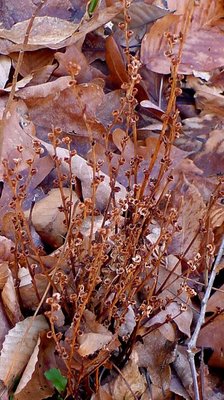
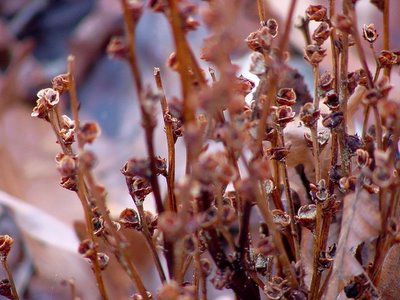
I'm fairly certain that these were Beechdrops (Epifagus virginiana), a plant that's parasitic on the roots of Beech trees.

I've never seen them before, even though many references call them "common". They probably bloomed in October, but from the photos I've seen, they look about the same whether they're blooming or not. (No chlorophyll.)


OK, I guess you have to be a total wildflower geek to think that this is exciting. But I am, so I do!

Interesting write-up with historical references here.

Tuesday, February 4, 2014

Yard sale!


A few new things if you are in the market and the right size... Baruntse size 43.5, TRAB skimo race bindings, couple pair of skisand some shells and insulation.....among other things.


http://coldthistletools.blogspot.com//03/yard-sale.html


Gotta pay for those new toys to review some how ;-)