
Cycling in New England,I've had my share of encounters with strong winds. Or at least, what I considered strong winds. Here in Northern Ireland they are on an entirely different scale. Part of it is the open landscape. Much of the time, you are cycling through glens (undulating grassy hills), without much in the way of trees for cover. Even the mountains tend to be all grass and rock, with only the occasional clump of forest.This quality of the landscape is part of what makes cycling here so special - the open, panoramic views are ever-present, encouraging on climbs and breath-taking on descents. But on windy daysthere is little in the way of shelter. Cycling in a group, the riders can shelter each other. Cycling alone, you are exposed to it all.
And the windy days can be unpredictable. I have gone out on a calm morning, only to battle violent gusts mid-ride. I have cycled down a straight road in what alternated between headwinds and tailwinds - confused, erratic currents.
One day last week, a headwind grew so strong and steady that, as I rode down a long steep hill it insistently pushed me back up. I could not have imagined such a slow, strenuous descent:It was as if some invisible giant had casually put his hand up against my handlebars.
But most disconcerting of all are the cross winds. I've had the least experience with these so far, but here they are common. Winds blowing sideways and on the diagonal can be strong enough to push the bike around the road. When the wind is steady, I find ways to either lean or position myself against it to reduce the impact. But when it is gusty, a sudden push against the side of the bike, or worst of all, the handlebars, can rattle my nerves. Faced with this, I try to keep simultaneously loose and hyper-ready to react to the blows with quick tiny counter-movements. And if the gusts get really bad, I wait it out: The weather is changeable; the pattern will morph into something else before long.
But the wind is not all bad. One night, I was cycling home along a 10 mile flat stretch. A tailwind picked up - so strong and so close to the ground, it felt as if the current settled in between my tires and the road, transporting me all the way home on a magic carpet ride.


 When Paintbox Press asked me to review Pop-Up Tour de France: the World's Greatest Bike Race by Pamela Pease, I agreed out of sheer curiosity - expecting a children's picture-book. Having now read it cover-to-cover, I must say that this is the most comprehensive and captivating explanation of the race I have come across, as a novice follower of the sport. Oh yes, and the pop-up illustrations are adorable!
 Written in a way that can be read by adults and precocious children alike, Pop-Up Tour de France begins with the history of racing and of the Tour itself, before plunging into a step-by-step explanation of how the race is organised and held today.
 Everything one might care to know - descriptions of the stages, explanations about how teams work together, race tactics, etc. - is spelled out in language that is interesting and understandable to a layperson, without being condescending or simplistic. Illustrations are done in what looks like pencil and gouache, occasionally combined with photos and logos collage-style. The pictures have a whimsical, half-finished quality to them that addstextural interest anda sense of spontaneity: Pencil marks are visible and the density of brush strokes is uneven. While parts of the same image might be rendered in great detail, other parts look almost like abstract colour blocks. Combined with the pop-up features, it all comes together well to attract the viewer's eye to even the most minute details of the illustrations. The book is exciting and succeeds in portraying the Tour de France as a very real and very appealing event.
 Then of course there is the cute factor. There are tiny cut-outs of jerseys for the various race stages.
 And things like this, where you get to see who's inside the team car by pulling on the tab, or who rides in the caravan by rotating a spinning wheel.Overall, the book comes across as well researched, though I am sure Tour aficionados would find plenty of slip-ups. The only thing I found off was a reference to a "back derailleur".
 Held since 1903, theTour de France is the most famous bicycle race in the world and takes place every year in July - In fact it is happening right now, and today is Stage 16. This year is the first time I've felt inclined to follow the Tour and I am not ashamed to admit that this wonderful pop-up book has contributed to my enjoyment and understanding of the coverage. Whether a novice or a seasoned follower, a child or an adult, the Pop-Up Tour de France is certain put a smile on your face and rev up your enthusiasm for cycling - be it on a racing bike across France or on a 3-speed around the block. I am delighted that a book like this exists about a sport that does not receive as much publicity as its fans would like. Thank you, Paintbox Press, for the opportunity to review it.
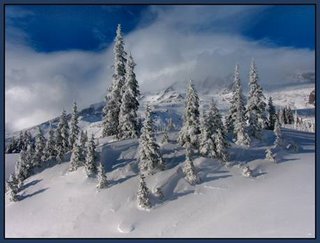

 Went out to check conditions at Confluence and SCII yesterday. We loaded up our bikes and gear and left the house around 7am. We decided to ride our bikes into Confluence to check conditions and possibly do some dry-tooling. I figured the ice would be a no-go since it hasn't been that cold very long. Since we hadn't had snow, the bike ride seemed like the logical way to get the flat 2.25 miles on the Rail/trail out of the way quicker. This only left the 800+ vertical gain up the hillside to the old quarry wall. It was the coldest morning of the season (about 12 degrees) I've never ridden my bike in mountaineering boots, but it worked out well. We took the ride slow and made it to the hike in about 10min. The sun was out, but it didn't seem to make it any warmer. Riding in sure did save the legs for the hill climb. It was about the easiest its ever felt. The hillside was frozen solid wit
 h a slight crust of snow in some areas. We saw the tracks of someone from what I would guess was the day before checking conditions or just trying to locate the ice. The tracks disappeared by the top of the hill and we didn't see any sign of them walking around near the ice, so maybe they didn't make it to the ice. Confluence has been an elusive place for many people to find. I've heard stories of folks hiking around for 7 hrs trying to find the place (they paid and were being guided believe it or not). Well we made it to the cliff, and as I expected the wall had ice in many places, but was in the process of being washed out due to all the water
  run off. Confluence, for the most part is one of the least reliable places to climb in the region. It gets direct sun and melts out very quickly. It also has old mine openings at the bottom that spew warm air up under the ice and causes it to melt out from the backside. We thought we would be able to check out some dry tooling possibilities, but there was soooo much water running, that it would've been completely miserable to even try to give anything a go. We hung out for about 30min. watched tons of ice fall on every line and decided to head back to the car. On the way out, we stopped at the old stone walls near the bottom of the hill to pick around for a minute and shoot some photos. We made the ride out and decided to go check conditions at SCII.


 Waterspouts are tornadoes that are over the water instead of land. And they are something else to watch.

 You learn something new every day!


